7.2.1.6. Touch
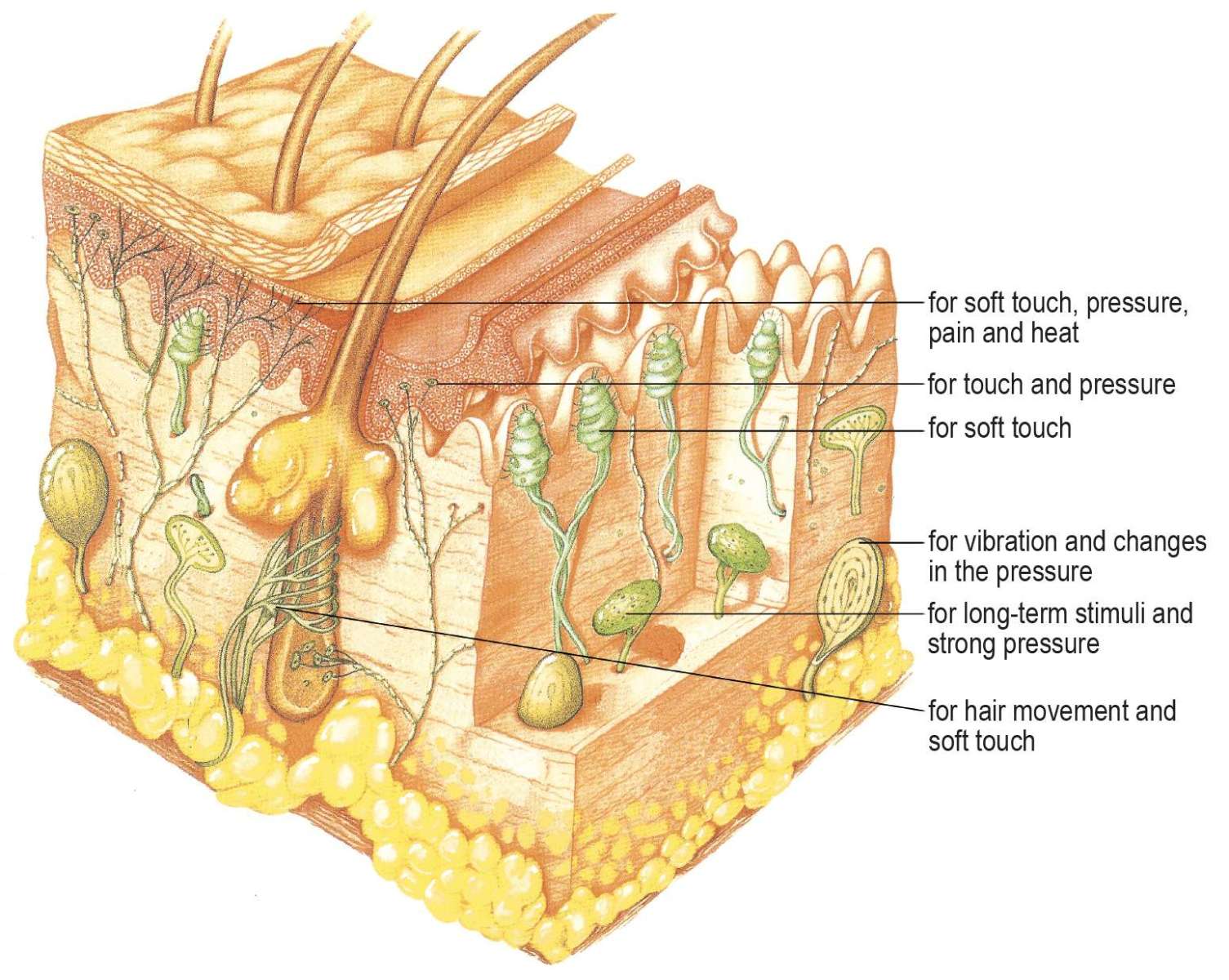
The somatosensory system as one of the human senses is often taken for granted. The somatic sensor is located in the organism’s multipurpose skin, differently configured in different areas of the body, depending on the purpose of an individual outer organ and the need for protecting it from external influences. In general, we can say that the skin has two or three parts, namely the outer layer or the epidermis, the middle layer or the dermis, and the subcutaneous layer or the hypodermis.
Compared to other segments of the skin, the outer part, which includes the hair, nails and sebaceous and sweat glands, is somewhat rougher and acts as the main defence against external influences in any organism. It very successfully protects the body from drying out, maintains body temperature by means of the sebaceous glands and, in cooperation with the ethereal body, prevents bacteria from invading the body.
The middle part of the skin, the dermis, is the most interwoven with blood capillaries: it contains all sensory systems and is, in a way, the liveliest part of the skin. The dermis contains somatic sensors which mainly detect the mechanical influences like pressure and touch, coldness and heat, and pleasure and pain.
The hypodermis as a fatty tissue prevents the emission of body warmth, maintains body temperature and simultaneously contains the somatic nerves leading to the brain. It also protects body organs from mechanical injuries.
Skin diseases could be divided into two groups: injuries caused by external influences, and internal injuries or body imbalances.
Internal imbalances are connected with specific diseases. Usually, the somatic sensors are greatly hindered in such conditions.
External injuries and epidermis destruction or deeper injuries also result in the destruction of the somatic sensors. Mechanical, chemical and other injuries to the skin cause lesions and constitute open areas exposed to virus attacks. With such injuries it is helpful to use Rules IV and V, enabling a faster renewal and healing of the skin tissue. One must be careful when diagnosing an injury, because almost all such injuries are tied to black magic, spells or curses.
One must also determine whether the somatic sensors suffer from lasting damage or not, so that the therapist can return skin sensitivity to the original state.
The organism’s defence system fails if an injury has destroyed a too large percentage of the skin, like in burns of thermal or chemical origin. In such cases we perform therapies every day or even twice a day to enable the organism’s defence system to protect the body against destruction despite the large amount of damage. When a person suffers from burns the cells, typically, lose water, which must be replaced immediately. A large number of cases confirm that the victims who soaked the injured part of the body in water immediately after the event protected 80 percent of the injured cells against destruction and returned them to life.