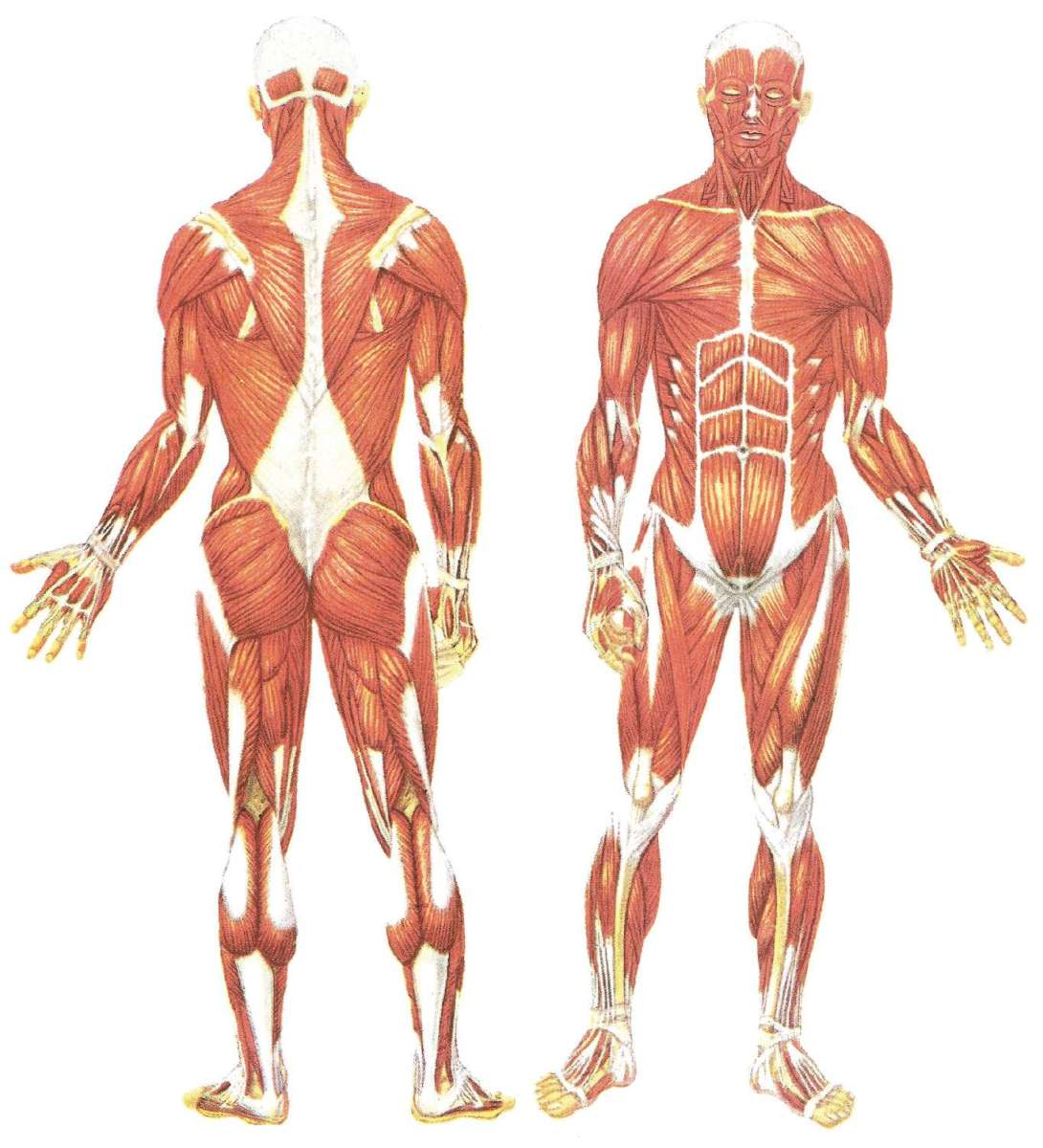
7.2.8. The Muscular System
The muscular system consists of 600 different muscles, distributed around the whole body, enabling conscious and subconscious movements of the body. In the joints, for instance, the muscles are attached to the bones and enable the joint to move, and the cardiac muscles enable the heart to operate. Muscles are made of muscle fibres, ending with tendons, attaching the muscles to the bones.
The muscles, crisscrossing the whole organism, can be divided to two groups: the muscles of the head and neck, and the muscles of the trunk and the extremities. Those of the head and neck move the neck, the back of the head, the eyes, the nose, the mouth and the skin in this area. The muscles attached to the skin and moving the skin on the face are called skin muscles. The muscles of the trunk and the extremities allow the movement of the limbs, maintain the position of the organs, enable the operation of the systems, and have different shapes with regard to their purpose: individual muscles are trapezoid, jagged, thick, wide and delta-shaped.
Muscles move the joints of two bones by reacting to the neural signal sent by the brain as a command and contracting. Muscles relax and loosen up when they are not receiving a neural signal. They need energy for their movements, and they receive it from the food consumed: they are its largest consumer. The operation of the muscles also enables certain processes in the organism, producing heat which the body discharges into the space through the skin.
The muscles constitute a system for the movement of all organs and systems in the body. Therefore, the energy control and healing of the muscles are performed when maintaining and examining an individual organ or system.
The muscles must have sufficient life energy.
Mechanically injured muscles heal more quickly and do not get infected if we treat them according to the transformation rules every second day. The method of mental cleaning is especially successful, with the energy used preventing infection.
The muscles must be active and the Tibetan Fountain of Youth, a method of maintaining physical fitness described in the chapter on the preparation of the therapist, gives excellent results. Walking in nature, doing of sports, especially running across an uneven terrain, maintain muscle activity. The known recreation systems of exercises and massages enable the activation of the muscles that are, so to speak, asleep.