7.2.4. The Digestive System
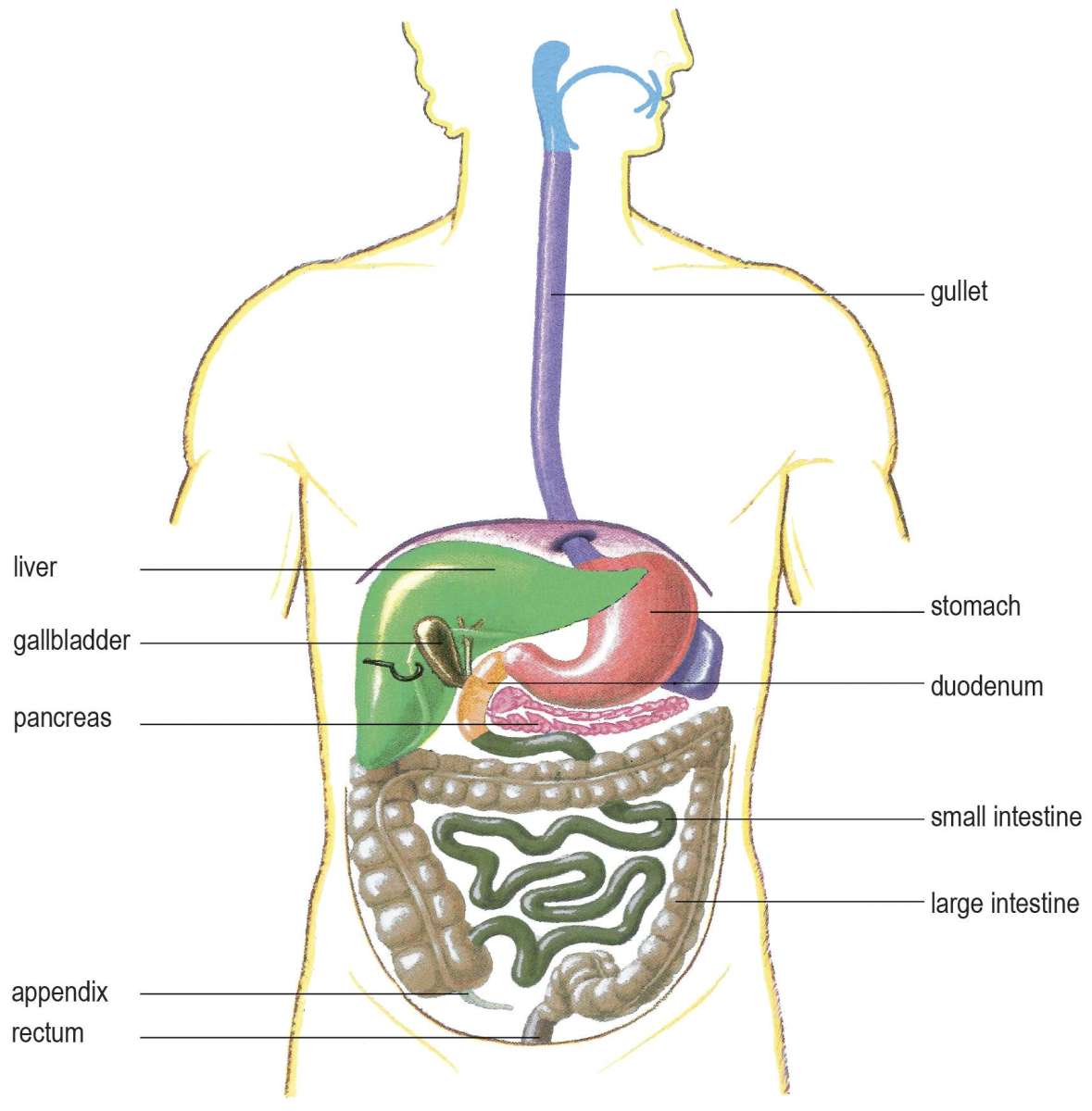
Essentially, the digestive system is responsible for the mechanical and chemical processing of food. The latter is mechanically and chemically prepared in the mouth, and then taken to the stomach where food decomposition process starts. The digestion continues in the duodenum, and the small and large intestines. The remainder of the food that is not digestible is excreted from the body through the rectum and the anus. The difference between digestible and indigestible food is that substances decomposable in water are nutritious, while all the others are indigestible. The blood receives nutritious substances via the capillaries and takes them to the cells to be used. The digestive tract is a good ten metres long and mainly located in the abdominal cavity under the diaphragm.
In the oral cavity, the teeth, the tongue and the salivary glands prepare food mechanically and chemically. Food, brought through the pharynx and the gullet, is received by the stomach and the process of softening, leavening and decomposition begins. Food decomposition is accelerated by the digestive glands: salivary glands, glands in the gastric and intestinal mucosa, the liver and the pancreas.
The initial part of the small intestine is called the duodenum, leading to which is the bile duct supplying substance needed for the digestion of lipids and removal of certain vitamins. At the output end, the bile duct is joined with the pancreatic duct, discharging pancreatic juice, important for the decomposition of certain acids, processing of polysaccharides into disaccharides, and the disintegration of lipids into fatty acids.
The large intestine is the last digestive organ, where indigested substances, ready for excretion, are temporarily stored. In this area many causes of illness are found.
In the digestive system, like in other system, we first control the life energy of the whole system and then of individual organs without this energy. We add the lacking energy to these organs with Rules IV and V.
The operation of the digestive system can be hindered by injuries and diseases like toothache, tonsils inflammation, stomach and bile problems, intestinal problems, especially those concerning the large intestine, the rectum and the anus. Consequently, the system must be regularly maintained. In the case of stomach problems, we must jointly examine and heal the stomach, the bile and the duodenum as a single organ. This is the only way to find which of the three organs is in fact injured or sick. Appropriate food consumption and advice according to the vegetarian principles stabilise the organs of the digestive system well.
The greatest danger for human health is the last part of the digestive system, the large intestine. The latter storages all waste material created through food digestion before it is defecated. This material contains different micro-organisms which stay here and put health at risk. Cancerous cells are also created in the large intestine.
The organism needs large amounts of water, and so it is indispensable to drink clean and healthy water. Sadly, today tap water is used as drinking water almost everywhere, although it is poisoned and can only serve as sanitary water. The most successful cleaning of the large intestine is considered to be urine enema.