7.2.5. The Urinary System
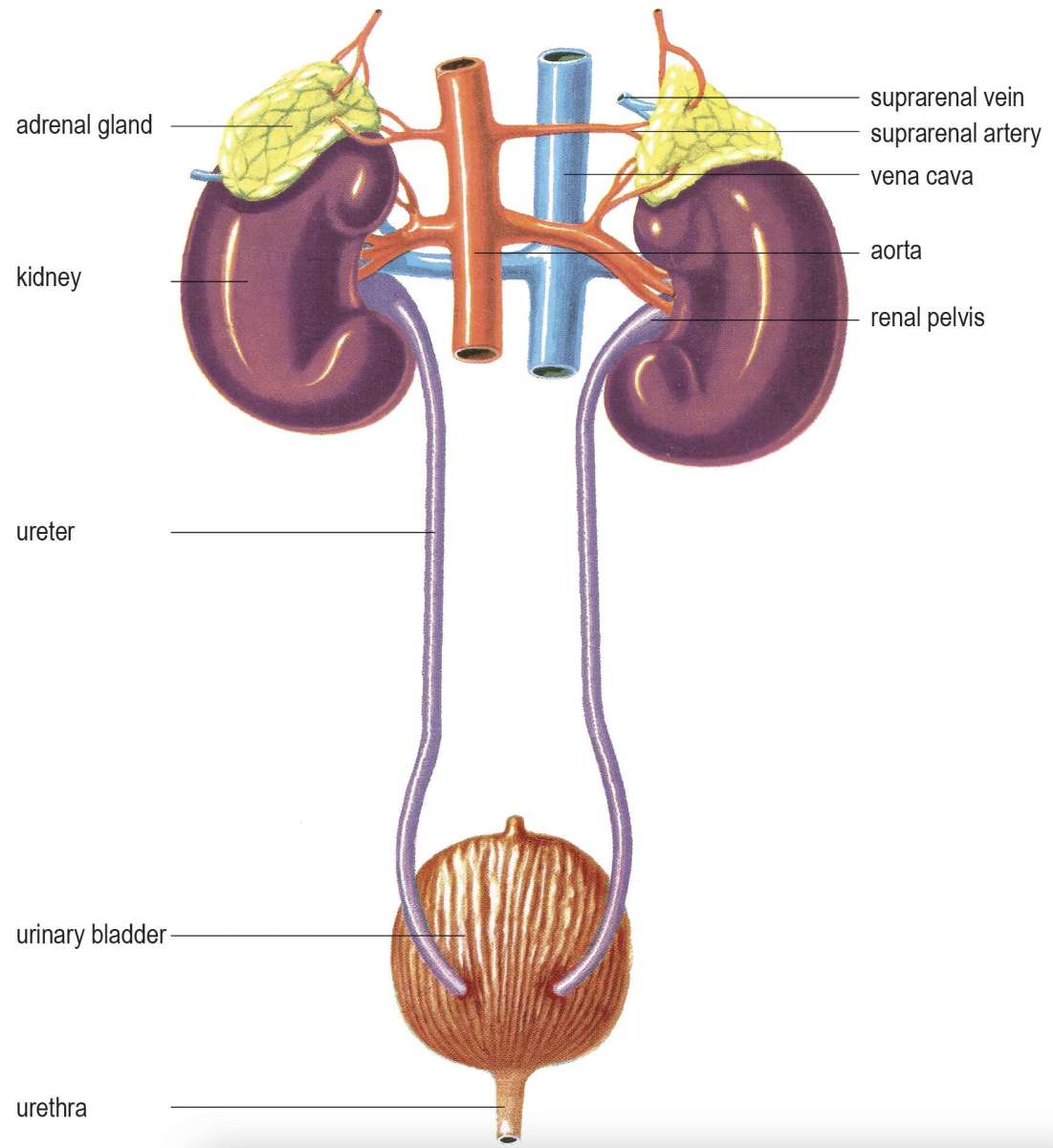
The urinary system is responsible for the excretion of the wastes produced during different processes in the body. The wastes are also excreted through the lungs, digestive organs and skin, but these ways are of an auxiliary character. The urinary process starts in the two kidneys producing urine, which contains wastes, dissolved and mixed in an appropriate amount of water, also including inorganic substances that the body does not need. The urine is conveyed by the two ureters to the urinary bladder and then excreted from the body through the urethra.
The two kidneys are located at the level of the lower thoracic and upper lumbar vertebrae. They are crisscrossed by capillaries and different systems of filter networks and outgoing tubes. The kidneys must continuously be supplied with a large amount of blood, which is why they are directly connected to the vena cava and the aorta.
The urine is collected in the renal calyx and passes through the ureter to the urinary bladder. The two ureters are flexible tubes made of circular and longitudinal muscles which propel the urine to the bladder.
The bladder is hollow, made of thin and flexible tissue, and can hold up to half a litre of urine on the average. The bladder is followed by the urethra of four centimetres with women and four times longer with men, because it passes through the prostate and has a longer way out, exiting through the corpus spongiosum of the penis.
The urinary system is examined, controlled and maintained with lifecosmic energy in the same way as shown for other systems, only that one must additionally consider the sensitivity of the kidneys and care for their proper functioning, since kidney disease can lead to serious and lasting consequences for the organism. Mental cleaning of the kidneys, first done for the left kidney and then for the right one, gives good results.
We always control the ureters at the second therapeutic session: with two fingers at a distance of some centimetres, we move the hand from the pubic bone upward to the kidneys above the ureters, and check the state along the entire length of the left and right ureters by means of the eye or intuitive sensor. Where the blinking stops, i.e. our sensor reacts, there is a hindrance in the ureter. We return the energy lost to the area with Rule I, or mentally clean the passage if it is blocked.
The bladder and the urethra are the last two parts of the urinary system. The bladder is often glued to the intestines due to a vacuum, which we correct with Rule I of the energy therapy.
The kidneys and the bladder may collect wastes in the form of stones, which cause great pain when moving through the urinary passages. Kidney, urinary bladder and gallbladder stones are removed by breaking the stones by means of mental surgery.
The flow of urine through the urethra is controlled by the urethral sphincter muscle; with men, the urethra passes through the prostate and depends on it. The flow of urine is regulated by our consciousness, and therefore, we can retain the urine in the bladder for a certain time.